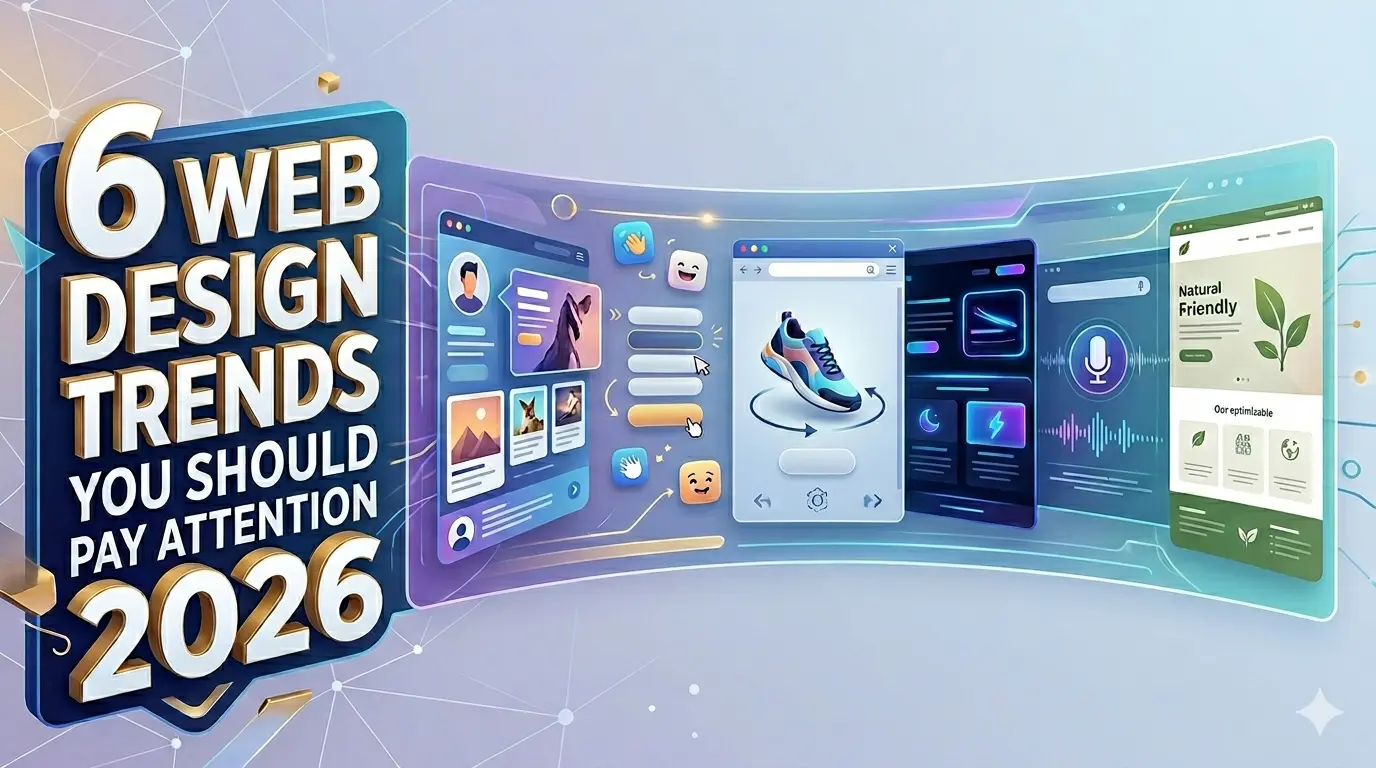
Did you know that 94% of first impressions are design-related? In today’s digital landscape, users decide within seconds whether to stay on a website or leave, making web design more critical than ever. As we move into 2026, design is no longer just about aesthetics, it’s about speed, usability, personalization, and creating seamless digital experiences that keep users engaged.
Here are the 6 web design trends you should pay attention to in 2026:
1) AI-Assisted Design and Content
2) Performance-First Design Over Visual-First Design
3) Personalised User Experiences
4) Strategic Minimalism
5) Conversion-Focused UX
6) Modular and Scalable Design Systems
7) Accessibility Is Becoming a Standard Requirement
1- AI-Assisted Design and Content
AI-assisted design and content creation is transforming how modern websites are built, optimized, and maintained. Instead of manually handling every design element or writing all content from scratch, designers and developers are increasingly using AI tools to speed up workflows, generate layout ideas, and produce high-quality copy in seconds. This shift allows teams to focus more on strategy, creativity, and user experience rather than repetitive tasks.
In 2026, AI will play an even bigger role in real-time personalization, adaptive layouts, and automated A/B testing. Websites will not only be designed with AI support but will also continuously evolve based on user behavior and performance data. One of the biggest shifts is the role AI is playing in design, which we cover in depth.
However, the key advantage lies in using AI as a co-creator rather than a replacement—blending machine efficiency with human creativity to produce more intelligent, engaging, and conversion-driven digital experiences.
2) Performance-First Design Over Visual-First Design
In 2026, web design is shifting away from purely aesthetic-heavy interfaces toward performance-first experiences. While visually rich websites were once considered the gold standard, users today expect pages that load instantly, respond smoothly, and function flawlessly across all devices. A beautiful design loses its impact if it slows down the user journey or creates friction in navigation.
Performance-first design prioritizes speed, efficiency, and usability from the very beginning of the design process. This means optimizing images, reducing unnecessary animations, streamlining code, and making layout decisions that support fast loading times and seamless interactions. Search engines also reward performance-focused websites with better rankings, making it a critical factor for SEO success.
Ultimately, the goal is balance, creating designs that are still visually appealing but never at the cost of performance. In today’s world, the most successful websites will be those that look good, load fast, and deliver a smooth user experience without compromise.
Why is this shift happening
This shift toward performance-first design is happening because user expectations and technology standards have changed significantly. Today’s users have little patience for slow or clunky websites, if a page takes more than a few seconds to load, they are likely to leave and never return. This has forced businesses to prioritize speed and usability over purely decorative design elements. Many of these trends lean on strong visual design, which we also handle.
3) Personalised User Experiences
Personalised user experiences are transforming how websites engage with visitors by tailoring content, layout, and interactions based on individual user behavior and preferences. Instead of delivering a one-size-fits-all experience, modern websites now adapt dynamically to create more relevant and meaningful journeys for each user.
This shift is powered by data, automation, and real-time behavioral tracking, allowing businesses to understand what users want and deliver it instantly. As a result, engagement increases, bounce rates decrease, and conversion rates improve significantly.
Key elements of personalised user experiences include:
- Dynamic content that changes based on user behavior, location, or interests
- Product and content recommendations tailored to individual preferences
- Personalized homepage layouts for returning visitors
- Behavior-based email and on-site messaging triggers
- AI-driven insights that predict user intent and needs
- Real-time customization of offers, banners, and calls-to-action
Ultimately, personalized experiences make websites feel more natural, relevant, and human-like. Users no longer see personalization as a bonus feature, they now expect it as a standard part of every digital interaction.
4) Strategic Minimalism
Strategic minimalism is a modern design approach that focuses on purposeful simplicity. Instead of removing elements just for the sake of a “clean look,” it prioritizes clarity, usability, and intent, ensuring every element on the page serves a clear function and supports the user journey.
This approach helps reduce distractions, improve readability, and guide users more effectively toward key actions. It also enhances performance by eliminating unnecessary visual clutter and streamlining the overall experience.
Key elements of strategic minimalism include:
- Clear visual hierarchy that guides user attention naturally
- Purpose-driven layouts where every element has a defined role
- Reduced visual clutter to improve focus and readability
- Strong use of spacing and whitespace for better structure
- Simplified navigation to reduce user effort and confusion
- Limited but impactful use of color, typography, and imagery
- Faster loading times due to fewer heavy design elements
This approach creates websites that feel clean, focused, and easy to navigate, while ensuring every design choice supports clarity, purpose, and user engagement.
5) Conversion-Focused UX
Conversion-focused UX is a design approach where every element of a website is intentionally structured to guide users toward a specific action. Instead of focusing only on aesthetics or general usability, this strategy prioritizes measurable outcomes such as sign-ups, purchases, inquiries, or downloads.
It combines user psychology, data analysis, and design principles to reduce friction and make decision-making easier for visitors. By simplifying journeys and removing distractions, websites can significantly improve engagement and conversion rates.
Key elements of conversion-focused UX include:
- Clear and compelling call-to-action (CTA) buttons placed strategically across pages
- Simplified forms that reduce effort and increase completion rates
- Intuitive navigation that guides users toward key goals
- Trust-building elements such as reviews, testimonials, and social proof
- A/B testing to continuously optimize performance and user flow
- Logical page structure that supports smooth decision-making
- Reduced friction in checkout or inquiry processes
This approach ensures that design is not just visually appealing but also highly effective in driving real business results by turning visitors into customers.
6) Modular and Scalable Design Systems
Modular and scalable design systems focus on building websites with reusable components rather than designing every page from the ground up. Instead of treating each section as a one-off layout, designers create flexible building blocks—such as headers, content sections, buttons, and cards—that can be reused across multiple pages while maintaining consistency.
This approach ensures a unified visual identity through standardized typography, colors, spacing, and layout structures. It also improves collaboration between designers and developers by creating clear guidelines and documentation that keep everyone aligned throughout the project.
A modular system makes websites easier to update, expand, and maintain over time. As businesses grow and digital needs evolve, new pages or features can be added without disrupting the overall structure, allowing the website to scale efficiently while preserving performance and design consistency. Want these trends on your own site? We can apply these trends to your own site for you.
7) Accessibility Is Becoming a Standard Requirement
Accessibility is no longer viewed as an optional feature—it is becoming a fundamental requirement in modern web design. Websites are expected to be usable by everyone, including people with visual, auditory, motor, or cognitive disabilities. Designing with accessibility in mind ensures that no user is excluded from interacting with digital content.
This shift is driven by both ethical responsibility and legal considerations. Many countries now have accessibility regulations that require businesses to meet specific standards, such as proper color contrast, keyboard navigation support, alt text for images, and screen reader compatibility. Ignoring accessibility can not only harm user experience but also expose businesses to legal risks.
Beyond compliance, accessible design improves usability for all users. Clear typography, readable layouts, structured content, and intuitive navigation benefit everyone—not just those with disabilities. When accessibility becomes a core part of the design process, websites become more inclusive, user-friendly, and future-proof.
Why these Web Design Trends Matters for your Businesses
A modern, user-focused website improves first impressions, builds trust, and increases engagement, all of which influence conversions and revenue. When your website aligns with evolving user expectations—such as speed, personalization, accessibility, and seamless experience—it becomes a powerful business asset rather than just a digital brochure. Adapting to these trends ensures your brand stays competitive, relevant, and capable of turning visitors into long-term customers.
FAQs
1) Why is it important to follow web design trends?
Following web design trends helps businesses stay competitive and aligned with user expectations. Modern users expect fast, intuitive, and personalized experiences. Keeping your website updated ensures better engagement, improved SEO performance, and higher conversion rates.
2) Do I need to redesign my entire website to follow new trends?
Not necessarily. Many trends—such as improving performance, enhancing UX, or adding personalization—can be implemented gradually. A full redesign may be beneficial if your website is outdated, but strategic updates can often deliver strong results.
3) Is AI replacing web designers?
No. AI is a tool that assists designers by speeding up workflows, generating ideas, and analyzing data. Human creativity, strategy, and decision-making remain essential for building meaningful and conversion-focused digital experiences.
4) What is the difference between minimal design and strategic minimalism?
Minimal design focuses mainly on visual simplicity, while strategic minimalism emphasizes purpose. Every element is intentionally placed to guide users, reduce distractions, and support business goals.
5) Which trend should businesses prioritize first?
Performance and user experience should typically come first, as they directly impact engagement, SEO, and conversions. Once the foundation is strong, businesses can layer in personalization, AI tools, and scalable design systems for long-term growth.