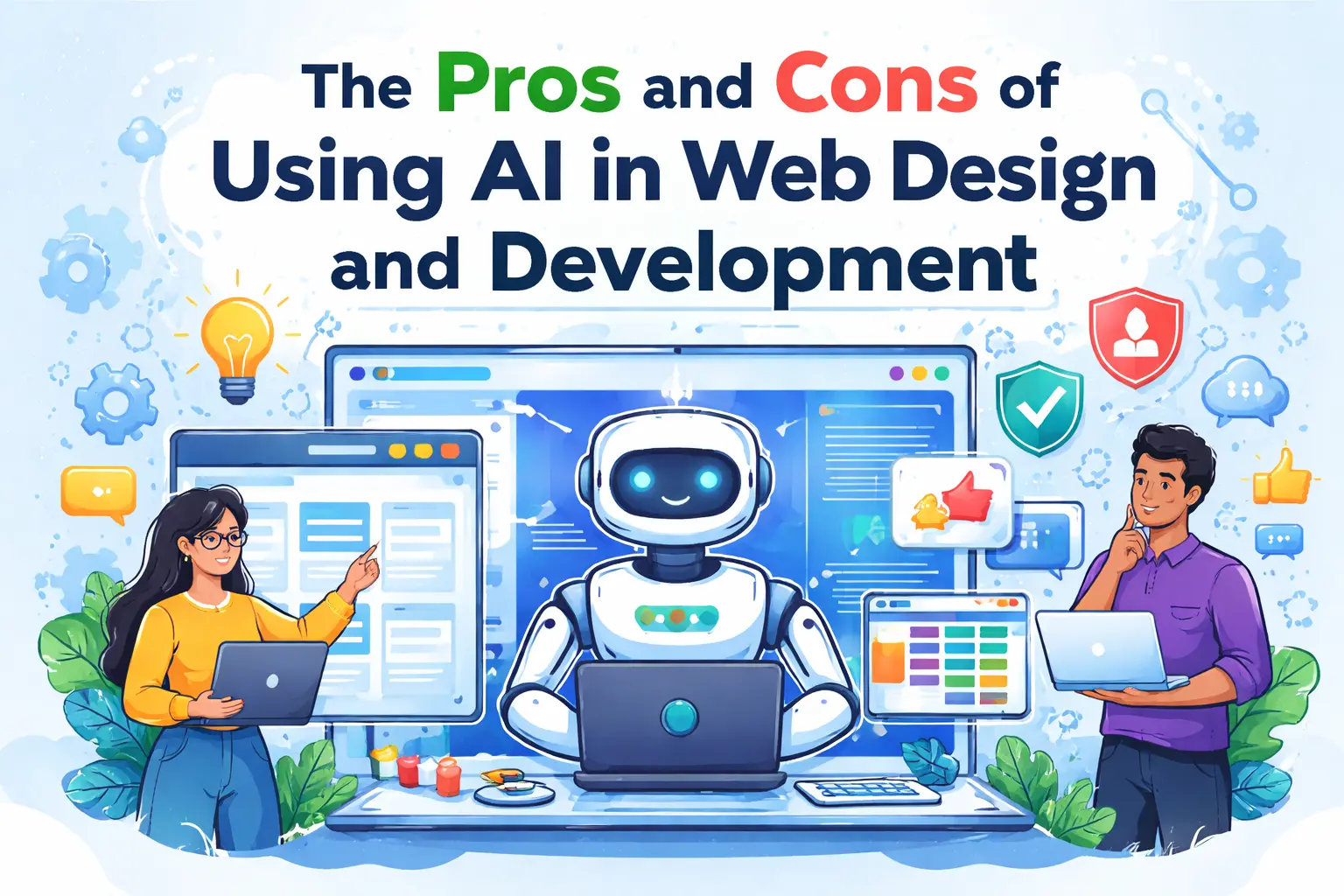
“Artificial intelligence is the new electricity,” as Andrew Ng famously stated. Its influence is now deeply embedded in web design and development, powering everything from automated layouts to code generation and content creation. While AI offers speed, scalability, and cost efficiency, it also raises questions about originality, strategy, and long-term flexibility.
Our guide will tell you all about the pros and cons! Ready to learn? Let’s get started.
Pros of Using AI in Web Design
1) AI Can Significantly Speed Up Website Development
AI has significantly accelerated the website development process by automating many time-consuming tasks. From generating code snippets and layouts to creating content and optimizing design structures, AI tools help developers move from concept to execution much faster than traditional methods. This allows businesses to launch websites in shorter timeframes without compromising basic functionality or design quality.
By reducing manual effort, AI enables designers and developers to focus more on strategy, user experience, and customization. However, while speed is a major advantage, it still requires human oversight to ensure the final product aligns with brand goals and delivers a seamless user experience.
AI’s impact on development speed is not just theoretical—it’s already measurable. A report by McKinsey & Company suggests that automation tools, including AI, can reduce software development time by up to 30–50% in certain workflows. This means tasks that once took days can often be completed in hours, especially when generating boilerplate code, layouts, or content structures.
However, speed should always be balanced with quality. While AI can accelerate production, human developers are still essential for ensuring usability, brand alignment, and long-term scalability. The most effective approach is a hybrid one, where AI handles repetitive work and humans focus on strategy and refinement. For web design that blends smart tools with real expertise, talk to H Grant Designs.
2) AI Can Reduce Initial Website Costs
AI can significantly reduce the initial cost of building a website by automating many of the foundational tasks that traditionally require time and skilled labor. From generating basic layouts and writing starter code to producing content and design elements, AI tools streamline early development work. This allows businesses to launch websites faster while keeping production expenses much lower than conventional methods.
By minimizing manual effort in the early stages, AI makes web development more accessible for startups and small businesses with limited budgets. Instead of investing heavily in large development teams, companies can allocate resources more strategically toward branding, marketing, and business growth. This shift helps reduce the financial barrier to establishing a strong online presence.
In many cases, AI also helps reduce revision cycles by quickly generating multiple design or content variations. This speeds up decision-making and allows teams to test ideas faster without additional development costs. As a result, businesses can move from concept to a functional website more efficiently while maintaining tighter control over their budget. If AI has you reconsidering, read why a designer beats an AI builder.
3) AI Can Improve Design Efficiency Through Automation
According to research by Adobe, designers spend nearly 30% of their time on repetitive tasks that could be automated. This is where AI is transforming the workflow by significantly improving design efficiency through automation.
Also, many AI design tools can easily suggest the following:
- Layout arrangements
- Font pairings
- Colour palettes
- Image placements
However, true design quality still depends on human judgment. While AI can enhance efficiency, it cannot fully understand brand identity, emotional appeal, or complex user behavior. The best results come from combining AI-driven automation with human creativity to produce designs that are both efficient and meaningful.
4) AI Can Assist Developers With Coding
One thing to note is that AI coding tools can always help developers write code a whole lot faster and even identify errors. They do improve productivity, but will still require a lot of human insight.
Thing is that AI coding assistants are becoming very common in web development workflows. These tools can easily generate code snippets, detect bugs, and suggest optimizations. This will then reduce development time and improve general efficiency.
For experienced developers, this is similar to having an intelligent autocomplete system. It accelerates technical tasks but does not replace the need for architecture decisions or testing. Another advantage is debugging support. AI tools can identify potential code issues early, reducing the risk of performance problems later. See how we balance tools and craft in our recent projects.
However, AI-generated code still requires review. Without human validation, automated suggestions may introduce inefficiencies or security concerns.
5) AI Can Help With Content Creation
AI can play a major role in assisting developers by simplifying and speeding up the coding process. From generating basic code structures to helping build components and functions, AI tools reduce the amount of manual effort required in everyday development tasks. This allows developers to move from idea to implementation more quickly and efficiently.
It can also support developers by suggesting code improvements, identifying potential errors, and offering alternative solutions in real time. This makes the development workflow smoother and helps reduce the chances of basic mistakes. For repetitive tasks like creating forms, layouts, or simple integrations, AI can significantly cut down development time.
While AI is highly useful in accelerating coding tasks, it works best as an assistant rather than a replacement. Developers still play a critical role in ensuring that the code is secure, scalable, and aligned with project requirements. By combining AI efficiency with human expertise, development becomes faster without compromising quality.
Cons of Using AI in Web Design and Development
1) AI Websites Often Lack Strategic Thinking
AI can quickly generate websites, but it often lacks the deeper strategic thinking required for long-term business success. While it may produce visually acceptable layouts and basic structures, it does not fully understand business goals, target audiences, or conversion strategies. As a result, the final output may look complete but still fail to perform effectively.
True web design goes beyond appearance—it requires planning how users will interact, navigate, and take action on a site. This includes understanding user intent, brand positioning, and funnel optimization, which AI cannot fully interpret on its own. Without this strategic layer, websites risk becoming generic and less impactful.
For this reason, human input remains essential in shaping direction and purpose. Designers and strategists ensure that every element of a website is aligned with business objectives, creating a digital experience that not only looks good but also drives meaningful results.
2) Customisation Can Be Limited
Every business has its own goals, audience, and visual direction, which often require tailored design solutions. AI tools may struggle to accommodate complex requirements such as advanced animations, custom user flows, or highly specific branding needs. As a result, the final output can sometimes feel generic or too similar to other AI-generated sites.
For businesses looking to stand out, this limitation becomes significant. Human designers are better equipped to craft fully customized experiences that align with brand strategy and user expectations. By combining creativity with technical flexibility, they can build websites that are not only functional but also distinctive and memorable.
This is why many companies eventually migrate to more flexible platforms like WordPress web development environments and why they also look into hiring the best website design company.
3) AI May Create SEO Limitations
AI-generated websites can sometimes fall short when it comes to advanced SEO strategy. While they may handle basic on-page elements like headings, meta tags, or simple content structuring, they often lack a deeper understanding of search intent, competition, and long-term ranking strategy. This can result in websites that are technically functional but not fully optimized for visibility.
Effective SEO goes beyond automation—it requires strategic keyword planning, content mapping, internal linking structure, and user behavior analysis. AI tools may not always align these elements with business goals or adapt them to changing search engine algorithms. As a result, opportunities for higher rankings and organic traffic growth can be missed.
For sustainable SEO performance, human expertise is still essential. SEO specialists and web strategists ensure that every page is built with intent, structure, and scalability in mind. When combined with AI efficiency, human-driven SEO strategy helps create websites that are not only fast to build but also strong in long-term search performance.
4) AI Cannot Fully Replace Human UX Decisions
AI can assist with basic UX suggestions, but it cannot fully replace the depth of human decision-making required to create truly effective user experiences. While it may recommend layouts or navigation structures based on patterns, it does not fully understand human emotions, intent, or the subtle behaviors that influence how users interact with a website.
Good UX design requires empathy, research, and real-world context. Designers consider factors like user psychology, cultural differences, accessibility needs, and business goals—elements that go beyond data patterns alone. AI can support this process, but it cannot fully interpret why users behave a certain way or how design choices impact their journey on a deeper level.
This is why human involvement remains essential in UX design. Designers refine and validate AI-generated ideas to ensure the final experience feels intuitive, meaningful, and aligned with user expectations. The strongest results come from combining AI efficiency with human understanding of behavior and experience.
5) Over-Reliance on AI Can Create Generic Websites
AI can make website creation faster and easier, but over-reliance on it often leads to designs that feel generic and repetitive. Since AI tools typically rely on existing patterns and datasets, they tend to produce similar layouts, structures, and visual styles across different projects. This can make it difficult for a brand to stand out in a competitive digital space.
A strong website should reflect a brand’s personality, values, and unique positioning. However, when too much of the process is automated, these distinctive elements can get lost. The result is often a visually acceptable website that lacks originality and emotional connection with the target audience.
To avoid this, human creativity must guide the process. Designers bring fresh ideas, storytelling, and strategic thinking that help shape a truly unique digital identity. When AI is used as a supporting tool rather than the main driver, it enhances efficiency without compromising originality.
When Businesses Should Use AI vs Hire a Professional Web Designer
Businesses often struggle to decide whether to use AI tools or hire a professional web designer. The right choice depends on goals, budget, complexity, and long-term growth plans. While AI works well for speed and cost-saving, professional designers bring strategy, customization, and scalability.
| Factor | Use AI Tools | Hire a Professional Web Designer |
|---|---|---|
| Budget | Limited budget, need a low-cost solution | Flexible budget for long-term investment |
| Speed | Need a website quickly (hours/days) | Can afford longer timeline for quality work |
| Complexity | Simple websites (landing pages, portfolios) | Complex websites (eCommerce, SaaS, custom systems) |
| Customization | Basic or template-based design is acceptable | Fully custom design aligned with brand identity |
| Strategy | Minimal focus on SEO or conversions | Strong focus on UX, SEO, and business goals |
| Scalability | Short-term or experimental projects | Long-term growth and scalability required |
| Uniqueness | Can tolerate generic layouts | Need a unique and standout brand presence |
FAQs
1. Can AI fully replace web designers and developers?
No, AI cannot fully replace humans. It assists with execution, but strategy, creativity, UX decisions, and brand understanding still require human expertise.
2. When should businesses use AI for building websites?
AI is best for simple websites, prototypes, landing pages, or projects with limited budgets and tight deadlines.
3. When is it better to hire a professional web designer?
A professional designer is ideal when you need custom design, strong branding, advanced UX, and a conversion-focused strategy.
4. Can AI create unique and creative website designs?
AI can generate variations, but it often relies on existing patterns, making it less effective at producing truly unique or brand-specific designs.