
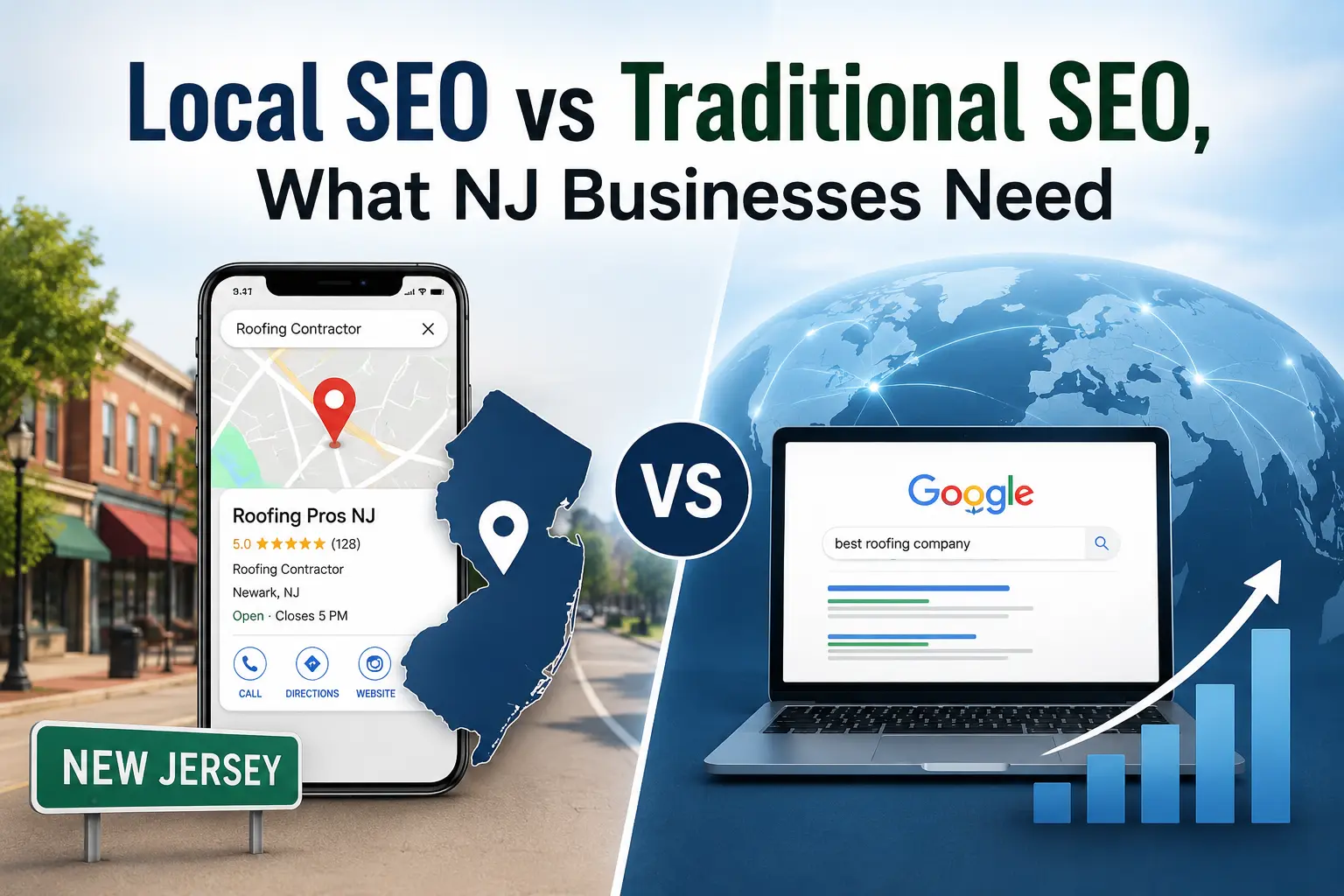
If you run a business in New Jersey and serve customers within a county, a town, and a short drive, local SEO is what you need first. Traditional SEO chases broad national rankings; local SEO puts your business in the map pack and “near me” results where Fair Lawn, Paramus, and Ridgewood customers actually search. The two share the same roots, yet they reward different signals and serve different buyers. This guide breaks down the difference and shows which one earns revenue for a New Jersey company.
Key Takeaways
- Local SEO targets people searching within your service area; traditional SEO targets a regional, national, and global audience.
- Local SEO ranks you in the Google map pack, Google Business Profile, and “near me” queries. Traditional SEO competes for the blue organic links.
- Google data puts local intent at roughly 46% of all searches, which makes local SEO the higher-ROI starting point for most NJ service businesses.
- Reviews, proximity, and Google Business Profile drive local rankings. Backlinks, domain authority, and content depth drive traditional rankings.
- A storefront in Glen Rock and a national e-commerce brand need opposite playbooks. Match the strategy to who buys from you.
What Traditional SEO Actually Does
Traditional SEO, often called organic SEO, works to rank your website for keywords no matter where the searcher sits. A New Jersey accounting firm using traditional SEO for the term “tax deductions for freelancers” competes against every blog and brand in the country. The payoff is reach. The cost is time and authority you have to earn over many months.
This approach leans on three pillars. Content depth answers the searcher’s question better than competing pages. Backlinks from credible sites tell Google your pages deserve trust. Technical health keeps the site fast, crawlable, and mobile-friendly. Each pillar compounds slowly, which is why broad terms can take 12 to 24 months to crack page one.
Traditional SEO fits businesses whose customers could be anywhere. Online stores, SaaS products, publishers, and national service providers live and die by it. For a Wyckoff bakery, ranking nationally for “best sourdough recipe” brings traffic that rarely walks through the door.
What Local SEO Actually Does
Local SEO optimizes your presence for geographically tied searches. When someone in Paramus types “plumber near me” and “web designer Bergen County,” Google shows a local pack, a map and three business listings sitting above the organic results. Landing in that pack puts you in front of people who are ready to call, visit, and buy.
The signals differ sharply from traditional SEO. Proximity to the searcher, a complete Google Business Profile, consistent name-address-phone data across directories, and a steady flow of reviews carry most of the weight. A landscaper two miles from the searcher with 80 five-star reviews beats a distant competitor with a thinner profile, even on a weaker website.
Local SEO moves faster, too. A neglected Google Business Profile that gets categories, photos, hours, and review responses can climb in weeks, not quarters. That speed is why it tends to deliver a quicker, more measurable return for small and mid-sized NJ businesses.
How to Approach Local SEO
Local SEO is a set of moving parts that reinforce each other. Treat it as a system, not a one-time setup. The sections below walk through the pieces in the order that tends to pay off fastest for a New Jersey business.
Claim and Complete Your Google Business Profile
Your Google Business Profile is the single biggest lever in local search. Fill every field: categories, services, hours, photos, and a description written for real customers. Google reports that businesses with complete profiles earn around seven times more clicks than those with incomplete ones, and a full profile feeds the map pack that sits above the organic links. Keep it active with fresh photos and posts, since dormant profiles slip.
Build Town-Level Service Pages
One page trying to rank for five towns rarely wins any of them. Build a dedicated page for each area you serve, with content specific to that town rather than swapped place-names on a template. This structure tells Google which areas you cover and gives nearby searchers a page built for them.
Each town page should carry its own proof: local landmarks, neighborhood references, photos of nearby projects, and reviews from customers in that area. Generic copy with the town name dropped in reads as thin to both Google and the reader. Specificity is what earns the ranking.
Pair those town pages with a strong central hub. A firm offering professional SEO services across New Jersey can link out to each local page from that hub, passing authority down and signaling the full footprint of areas it covers.
Earn Reviews and Respond to Them
Reviews work as a ranking signal and a trust signal at the same time. Ask happy customers right after a job, make the link easy, and reply to every review, positive and negative. Volume, recency, and your responses all factor into how Google ranks you and how the next searcher judges you. BrightLocal’s Local Consumer Review Survey reports that the large majority of consumers read online reviews before choosing a local business, which makes a steady stream of recent local reviews hard for an outsider to match.
Keep Your Citations Consistent
Your name, address, and phone number need to read identically everywhere they appear: your site, Google, Yelp, directories, and social profiles. Mismatched details confuse Google and dilute your authority. Audit your listings, fix conflicts, and lock down a single format. Consistency here is unglamorous and quietly powerful.
The Core Difference Is Intent
Search intent separates these two strategies more than any technical factor. Traditional searches skew exploratory. Someone googling “what is responsive web design” wants to learn, compare, and read, and they may sit three states away. The funnel is long and the buyer is early.
Local searches skew transactional. Someone searching “web design company Fair Lawn” already knows what they want and is shopping for a provider nearby. They are deep in the funnel and close to a decision.
The behavior after the search reveals why this matters for revenue. Industry analyses of Google data report that about 76% of people who run a local search visit a related business within 24 hours. A local searcher is rarely browsing for fun. They have a problem now and want a nearby solution they can trust.
Local SEO vs Traditional SEO at a Glance
| Factor | Local SEO | Traditional SEO |
| Audience | People in your town, county, service area | National and global searchers |
| Primary goal | Calls, visits, and bookings nearby | Broad traffic and brand authority |
| Where you rank | Map pack, Google Business Profile, “near me” | Standard organic blue links |
| Top ranking signals | Proximity, reviews, GBP, NAP consistency | Backlinks, domain authority, content depth |
| Keyword style | “service + town” and “near me” terms | Broad, high-volume terms |
| Time to results | Weeks to a few months | 12 to 24 months for competitive terms |
| Best fit | Storefronts and local service businesses | E-commerce, SaaS, national providers |
Why This Matters for New Jersey Businesses
New Jersey is a cluster of dense, distinct towns where a customer in Ridgewood rarely wants a vendor in another county. That density turns geography into a sharp ranking advantage. A web design company in Glen Rock can dominate Glen Rock and the towns next to it long before it could ever rank nationally for “web design.”
The competitive math favors the focused player. Ranking for “SEO services” against agencies worldwide is a slow, costly fight. Ranking for “SEO services Paramus” pits you against a handful of nearby firms, and a strong Google Business Profile plus genuine reviews can put you in the map pack quickly. Town-level service pages, one for Fair Lawn, one for Wyckoff, one for Ridgewood, signal to Google exactly which areas you serve.
Reviews carry extra weight in tight-knit NJ markets where word of mouth already runs strong. A profile with dozens of recent, specific reviews from local customers reads as proof to both Google and the next person searching. That trust is hard for an out-of-area competitor to fake.
When Traditional SEO Still Earns Its Place
Local SEO is not the answer for every New Jersey business. A company selling products online to customers across the country needs traditional SEO, since geography does not decide who buys. A NJ-based software firm serving clients nationwide should invest in content and authority, not the map pack.
As Bill Gates put it, “Content is king,” and that holds for national reach. Broad informational keywords build the authority that wins research-stage searches and feeds a longer sales funnel. The mistake is defaulting to the wrong engine. A neighborhood service business pouring its budget into broad national keywords burns money on traffic that never converts. A national brand obsessing over a single town caps its own ceiling.
When a Hybrid Approach Works
Some New Jersey businesses get the best results from running local and traditional SEO together. A hybrid fits when you serve a local base today and want broader authority over time. The local engine brings revenue now; the content engine builds the domain strength that lifts everything later.
A practical split puts most early budget into local foundations, then layers in educational content once the map pack presence is solid. Picture a Bergen County medspa: local SEO captures “botox near me” bookings, and a library of treatment guides pulls research-stage traffic from a wider area. A town-focused page like local SEO for Fair Lawn businesses handles the nearby demand, and the broader guides build the site authority that lifts every page over time.
The table below shows which model fits common New Jersey business types and where a blend makes sense.
| Business Type | Best Fit | Why |
| Plumber, electrician, HVAC | Local SEO | Customers search “near me” and hire fast |
| Single-location restaurant | Local SEO | Foot traffic depends on map pack visibility |
| Law firm, dental, medspa | Hybrid | Local bookings now, authority content builds trust |
| Multi-location service brand | Hybrid | Local pages per town plus brand-level content |
| National e-commerce store | Traditional SEO | Buyers anywhere; geography does not gate the sale |
| SaaS and online courses | Traditional SEO | Audience is global and research-driven |
How to Choose the Right Approach
Start with one question: does a customer’s location decide if they can buy from you? If yes, lead with local SEO. If no, lead with traditional SEO. Most NJ service businesses, contractors, clinics, salons, law firms, and agencies fall firmly in the local camp.
Use this quick filter:
- Choose local SEO if you have a storefront, a defined service area, and customers who search with town names and “near me.”
- Choose traditional SEO if you sell online, serve clients regardless of location, and compete on broad informational terms.
- Blend both if you serve a local base now and want long-term authority, using the hybrid split described above.
Whatever the mix, the foundations overlap. A fast, mobile-friendly, well-structured website helps both. The difference is what you build on top: a polished Google Business Profile and local pages for one, deep content and backlinks for the other.
Frequently Asked Questions
What is the difference between local SEO and traditional SEO?
Traditional SEO ranks your website for broad keywords across a national and global audience. Local SEO ranks your business for location-based searches and places you in the map pack and “near me” results. The biggest difference is who you reach and the intent behind their search.
Is local SEO better than traditional SEO for small businesses?
For most small businesses with a physical location and a defined service area, local SEO delivers faster, more measurable returns. It targets people ready to buy nearby and usually costs less to compete. A small business selling online to a national audience is the main exception.
Can I do both local SEO and traditional SEO at the same time?
Yes. Many businesses run both, leading with local SEO to win nearby customers and layering in content and backlinks to build long-term authority. The two share technical foundations, so the work overlaps. Weight the effort toward the model that drives most of your revenue.
How long does local SEO take to show results?
Local SEO often shows movement within weeks to a few months, faster than traditional SEO. A complete Google Business Profile, consistent listings, and steady reviews can lift map pack visibility quickly. Competitive towns take longer than thinly contested ones.
Does local SEO work without a physical storefront?
Yes. Service-area businesses without a storefront still rank locally by setting a service area in their Google Business Profile and building local pages. NJ contractors, cleaners, and consultants who travel to clients use this model successfully.
What ranking factors matter most for local SEO?
Proximity to the searcher, a complete and active Google Business Profile, the volume and quality of reviews, and consistent name-address-phone data across the web carry the most weight. On-page signals and local backlinks support those core factors.