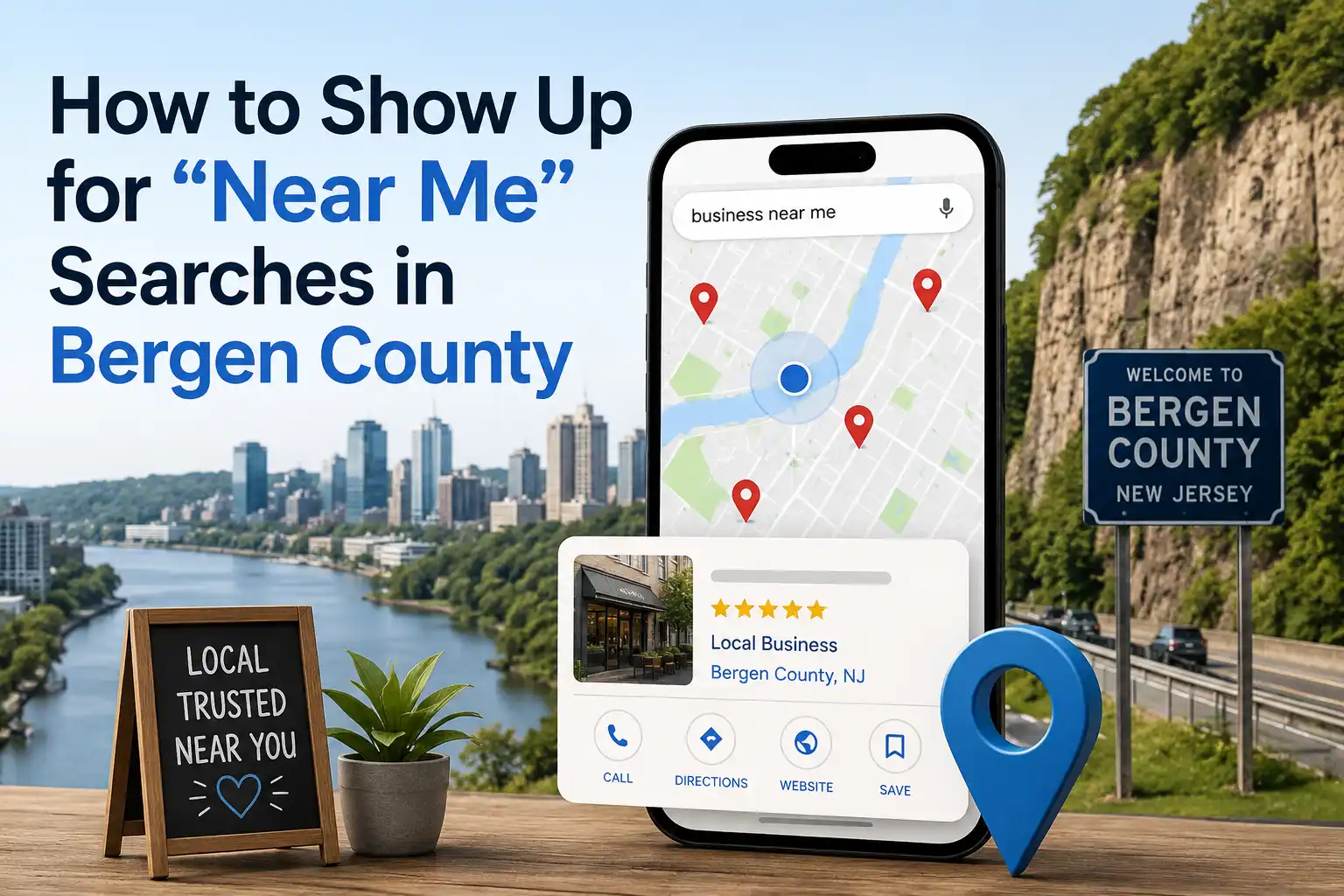
Showing up for “near me” searches in Bergen County comes down to three things Google weighs every time someone types “plumber near me” in Paramus at 9 p.m.: how prominent your business looks online, how relevant your profile and site are to the search, and how close you sit to the person searching. A fully built Google Business Profile, steady reviews, consistent name-address-phone data across the web, and town-level pages for Hackensack, Ridgewood, Teaneck, and the rest of the county move you into the three-business map pack that captures most of the clicks. The work is the same for a dentist in Fort Lee as for a roofer covering half the county. Get those signals right and your phone starts ringing for the searches that matter most.
Key Takeaways
- Google ranks “near me” results on prominence, relevance, and distance, with prominence carrying the most weight at roughly 60 percent of the algorithm.
- You cannot move your building, so the real leverage is the 85 percent of ranking you control through reviews, citations, and on-page relevance.
- Your Google Business Profile drives up to 32 percent of local pack placement, making a complete, active profile the highest-return task on the list.
- Bergen County packs more than 50,000 businesses into 70 municipalities, so town-level pages beat one generic “Bergen County” page every time.
- Mobile devices send over 82 percent of near me searches and use GPS, so fast pages, click-to-call, and directions decide who gets the call.
What Google Actually Means by a Near Me Search
A near me search is any query carrying local intent, even when the words “near me” never appear. “Emergency dentist Hackensack,” “AC repair open now,” and “best pizza” all trigger the same local machinery. Google reads the moment, the device location, and the wording, then decides which businesses fit the searcher standing in Glen Rock at that minute.
Google states plainly in its own documentation that local results rest on relevance, distance, and prominence. Those three signals form the backbone of every map pack and Maps result, and aligning your business with them is the heart of any local SEO services strategy for New Jersey businesses. The searcher rarely types a town for these queries, so Google fills the gap using GPS on a phone and an IP address on a desktop.
These are not idle searches. A person hunting for a corporate attorney before signing a contract, a parent searching for an urgent care at midnight, a homeowner with a burst pipe in Wyckoff, all act on the result they see first. High intent and immediate need sit behind the typical near me query, which is why the top three spots are worth fighting for.
The Three Signals That Decide Who Ranks
Industry analysis from Whitespark, Local Falcon, and Sterling Sky has tracked how Google weighs each signal, and the balance has shifted hard toward factors you control. Proximity once drove 25 to 30 percent of rankings; it now contributes closer to 15 percent. Prominence has climbed to roughly 60 percent, and relevance accounts for about 25 percent.
| Ranking signal | What it measures | Approx. weight |
| Prominence | How trusted and well-known the business looks through reviews, backlinks, citations, and branded searches | ~60% |
| Relevance | How closely the profile and site match the search, set by categories, services, and on-page language | ~25% |
| Proximity (distance) | How close the business sits to the searcher when no town is typed | ~15% |
The lesson hidden in that table is simple. A business two miles from the searcher can still lose to one slightly farther away when the closer option has thin reviews and a half-built profile. Distance sets the candidate pool; prominence and relevance pick the winners inside it.
Picture two roofers when someone in Ridgewood searches “roof repair near me.” Roofer A sits half a mile from the searcher, has 11 reviews averaging 3.9 stars, a profile with no service list, and a one-page website. Roofer B sits two miles out in Glen Rock, carries 180 reviews at 4.7 stars, lists every service with photos, and runs a dedicated Ridgewood page on its site. Google places both inside the candidate pool on distance, then ranks Roofer B above Roofer A, since its prominence and relevance dwarf the half-mile head start. The closer business loses the click even when it sits closer, since the two signals that carry 85 percent of the weight both point the other way.
Flip one variable and the order can flip back. Hand Roofer A a steady stream of fresh five-star reviews, a complete service list, and a real Ridgewood landing page, and its proximity advantage starts to count again. That is the practical takeaway. You compete on the parts you control, and they outweigh the part you cannot move.
Prominence builds trust over time
Prominence reflects how known and respected a business looks across the web. Reviews, backlinks, directory citations, and branded search volume all feed it. Review signals alone now represent about 20 percent of ranking factors, up from 16 percent a couple of years back, and Google reads the content and sentiment of those reviews, not just the star count.
Relevance is almost entirely in your hands
Relevance measures the match between the search and your profile plus site. Accurate categories, detailed service descriptions, and on-page language that names what you do and where you do it all reinforce the match. When your site architecture and profile categories point at the same topic, Google connects your business to the query with more confidence. This signal is close to fully controllable, which makes it the fastest lever to pull.
Proximity sets the starting pool
Distance still filters the candidates Google considers, especially on mobile where near me weighting climbs. You cannot relocate, yet you can shape how Google reads your reach through a clear address, defined service areas, and well-built pages for each town you cover. Service-area businesses set a radius inside the profile so locals in surrounding municipalities see them.
Does Your Website, Reviews, and Google Profile All Matter
Short answer, yes, and they work as a system rather than as a single button. The Google Business Profile gets you into the map pack, the website earns the trust and relevance that move you up it, and reviews tie both together by feeding prominence and the searcher’s decision at once. Lean on one and ignore the other two and the gaps show up fast in your ranking.
The Google Business Profile is the entry ticket
A missing profile, even a thin one, gets nothing else weighed, since the profile drives up to 32 percent of local pack placement. It is the asset Google reads first to decide proximity and relevance for a near me query. A complete, active profile with accurate categories, full services, photos, and current hours is the price of admission to the three results most searchers ever look at.
The website carries relevance and authority
Many owners assume the profile alone is enough, then wonder why a competitor with a real site outranks them. The website is where relevance gets proven through service pages, town-level landing pages, and clear on-page language that matches the query. It is also where authority lives, since backlinks point at your site, not your listing. A site that loads fast on mobile and names the towns you serve reinforces every signal the profile sends.
Reviews tie ranking and conversion together
Reviews now represent about 20 percent of ranking factors, and Google reads their content and sentiment, not just the star average. They lift prominence and they decide the click once a searcher compares the three options in front of them. A business with 4.7 stars and 180 recent reviews beats a 3.9-star listing with a dozen stale ones, both in the algorithm and in the customer’s head. Recency counts, so a slow trickle of fresh reviews outperforms a big batch that stopped a year ago.
Build and Optimize Your Google Business Profile First
Your Google Business Profile is the single highest-return asset in local search, accounting for up to 32 percent of local pack placement. Businesses that crack the local three-pack earn 126 percent more traffic and 93 percent more actions than those ranked below it. Treat the profile as a living local landing page, not a one-time setup.
- Claim and verify the listing so you control every field.
- Fill every section: hours, services, attributes, and a description that names your services and towns naturally.
- Add fresh photos every week with descriptive filenames, since active profiles read as trustworthy to Google.
- Respond to every review, good and bad, within a day, two at most.
- Post weekly updates and keep holiday hours current so the profile never looks stale.
Consistency matters as much as completeness. Businesses with matching name, address, and phone data across the web are 40 percent more likely to land in the local pack. Pick one exact format for your NAP and use it everywhere, from your site footer to every directory.
Win the Town-Level Game Across Bergen County
Bergen County is not one market. It is more than 70 municipalities, over 50,000 businesses, and roughly 20,000 new residents who arrived between 2020 and 2024. A searcher in Montvale and one in Englewood Cliffs sit 20 minutes apart, and Google treats them as separate local markets.
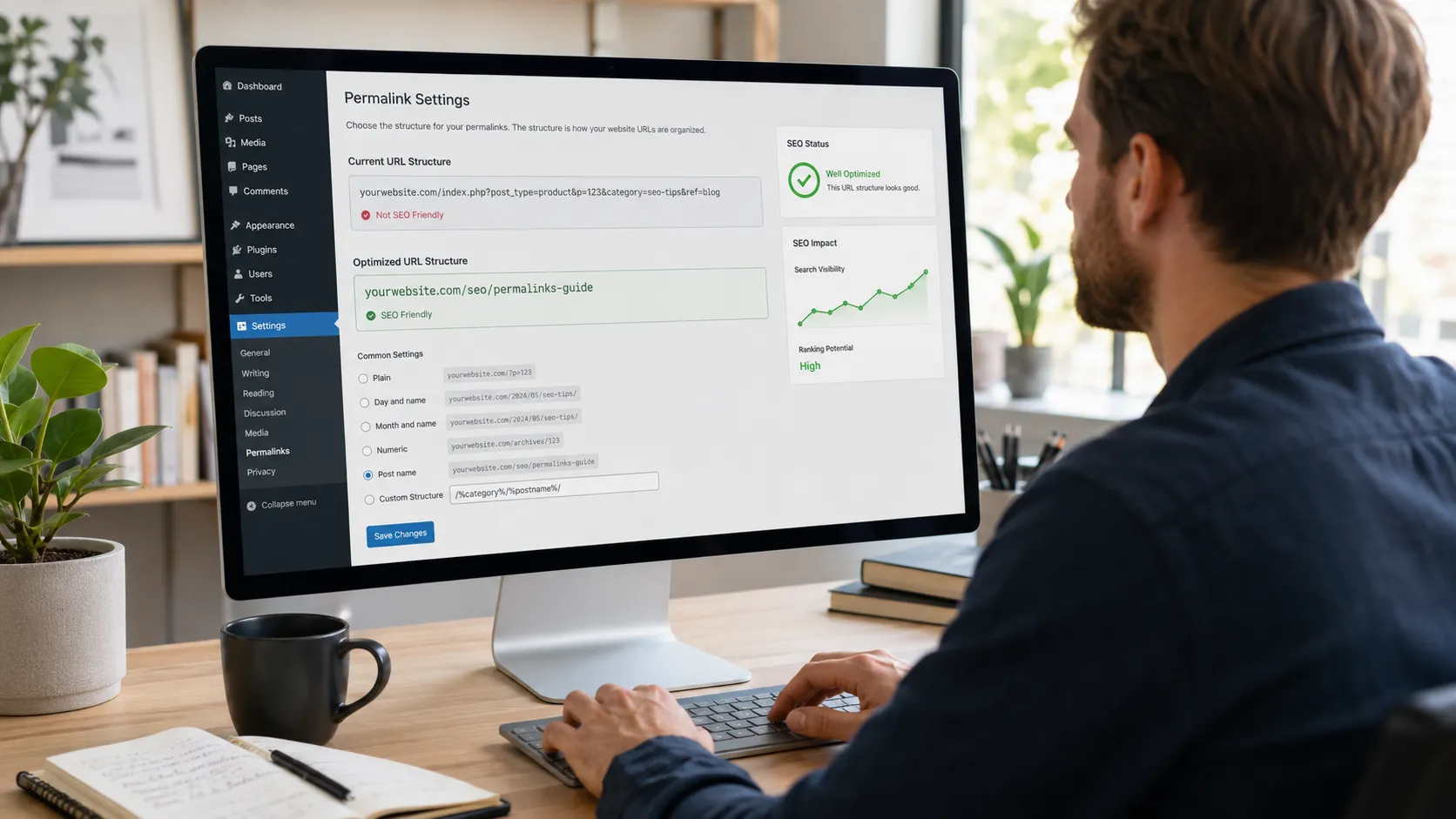
A single “Bergen County” page cannot rank for all of them. Service businesses that cover several towns need a dedicated page for each one, built for the people who live there rather than for a keyword tool.
- Name the town in the page title and headings, for example “Reliable Plumbing in Montvale” rather than a generic services line.
- Write genuinely local copy that mentions the neighborhood, nearby landmarks, and the services you run in that area.
- Add testimonials from customers in that specific town to prove you work there.
- Keep each page distinct so they do not compete against each other for the same search.
You do not need to repeat “near me” across the page. Google reads that phrase as a proximity modifier and does not expect to see it on your site. Specific town names, ZIP codes, and neighborhood references do far more work. For a look at how town-level targeting gets built out in a competitive local market, see our Ridgewood local SEO services .
Mobile and Technical Groundwork
Over 82 percent of near me searches happen on phones, and mobile devices pin a searcher to within a block using GPS. Desktop searches lean on IP geolocation, which often lands a town and sometimes two off. The split changes what you prioritize on each.
| Factor | Mobile search | Desktop search |
| Location method | GPS, accurate to the block | IP address, usually town-level |
| Precision | High, pins the searcher to a street | Lower, often the wrong nearby town |
| Share of near me queries | Over 82% | Under 18% |
| What to prioritize | Fast pages, click-to-call, directions | Town names in titles and content |
A slow site on a phone loses the customer before the page loads, and Google reads poor mobile performance as a reason to rank you lower. Fast load times, a working click-to-call button, and directions that open in Maps turn a search into a phone call. Local Business schema markup gives Google structured data on your location, hours, and reviews, which strengthens how clearly it understands the business.
Track the work with a geo-grid tool rather than a single rank check. Standard tracking misses near me performance since results shift by location. A grid of 15 to 25 points across your service area produces a heat map showing where you rank and where you slip, which tells you which towns need another page and where to gather more reviews.
Reviews, Citations, and the AI Shift
Maya Angelou once said people will never forget how you made them feel, and local reviews are where that feeling becomes a ranking signal. Ask for a review after every completed job, sale, and visit. A steady stream of recent, positive reviews lifts both your placement and the click decision once a searcher sees you.
Citations carry your NAP across directories and reinforce that your business is real and consistent. Audit where you appear, fix any mismatched listings, and add reputable local directories. Backlinks from Bergen County sources, a chamber of commerce, a local news mention, a community sponsor, add geographic weight that thin sites never earn.
AI Overviews have changed the surface too. When someone asks Google “who are some good plumbers in Bergen County,” an AI summary now lists businesses above the old results. Google pulls those names from the same prominence and relevance signals, so rich profiles with detailed services, FAQs, and strong reviews feed the AI answer as well as the map pack.
Mistakes That Quietly Sink Your Rankings
Some habits do more than waste effort. They actively push you down the results, and they are common enough that fixing them often moves the needle faster than any new tactic. Cut these early.
- Keyword stuffing. Repeating “Bergen County plumber” fifteen times on one page reads as spam to Google and to the human skimming it. Write naturally and let town names and services carry the relevance.
- Buying cheap backlinks. Bulk link services invite a penalty rather than a boost. One mention from a Bergen County chamber, a local paper, a community sponsorship outweighs a hundred junk links.
- Inconsistent NAP data. A name, address, and phone number that differ across your site, Yelp, and old directories confuse Google and cost you placement. Matching data makes a business 40 percent more likely to hit the local pack.
- Leaning on exact-match domains. A name like BergenCountyBestPlumber.com lost its weight years ago and now reads as spammy. A real brand name with a strong profile beats it.
- Ignoring negative reviews. A wall of unanswered one-star reviews sinks both ranking and trust. A calm, prompt reply often wins back the searcher who reads it.
- Treating SEO as a one-time setup. A profile built once and left alone goes stale. Weekly posts, fresh photos, and new reviews signal an active business, which Google rewards.
- One generic county page. Trying to rank a single “Bergen County” page for 70 towns spreads it too thin. Dedicated town pages each rank for their own area.
Frequently Asked Questions
Do near me searches use my location automatically
Yes. When a searcher leaves out a town, Google fills in their location using GPS on mobile and IP address on desktop, then ranks nearby options. You influence the result by strengthening the signals around your real address and service area, not by changing the searcher’s location.
Do I need to put the words near me on my website
No. Google treats “near me” as a proximity modifier and does not expect it on your pages. Specific town names, neighborhoods, and ZIP codes in your titles and content do the work instead, and they read far more naturally to customers.
How long does it take to rank for near me searches in Bergen County
Expect three to six months for noticeable movement, longer in competitive categories like plumbing and dentistry. Profiles that stay active and accumulate reviews every week climb faster than ones left untouched after setup.
Can a business rank for near me searches outside its own town
It is hard from a single location since proximity dominates these queries. Reaching nearby towns takes either a physical presence there, an exceptionally strong profile backed by reviews, citations, and town-level pages built for each area you serve.
What is the most important factor for ranking in the local pack
Prominence, at roughly 60 percent of the algorithm, carries the most weight, followed by relevance at about 25 percent and proximity at 15 percent. A complete, active Google Business Profile paired with steady reviews delivers the biggest gains for most Bergen County businesses.