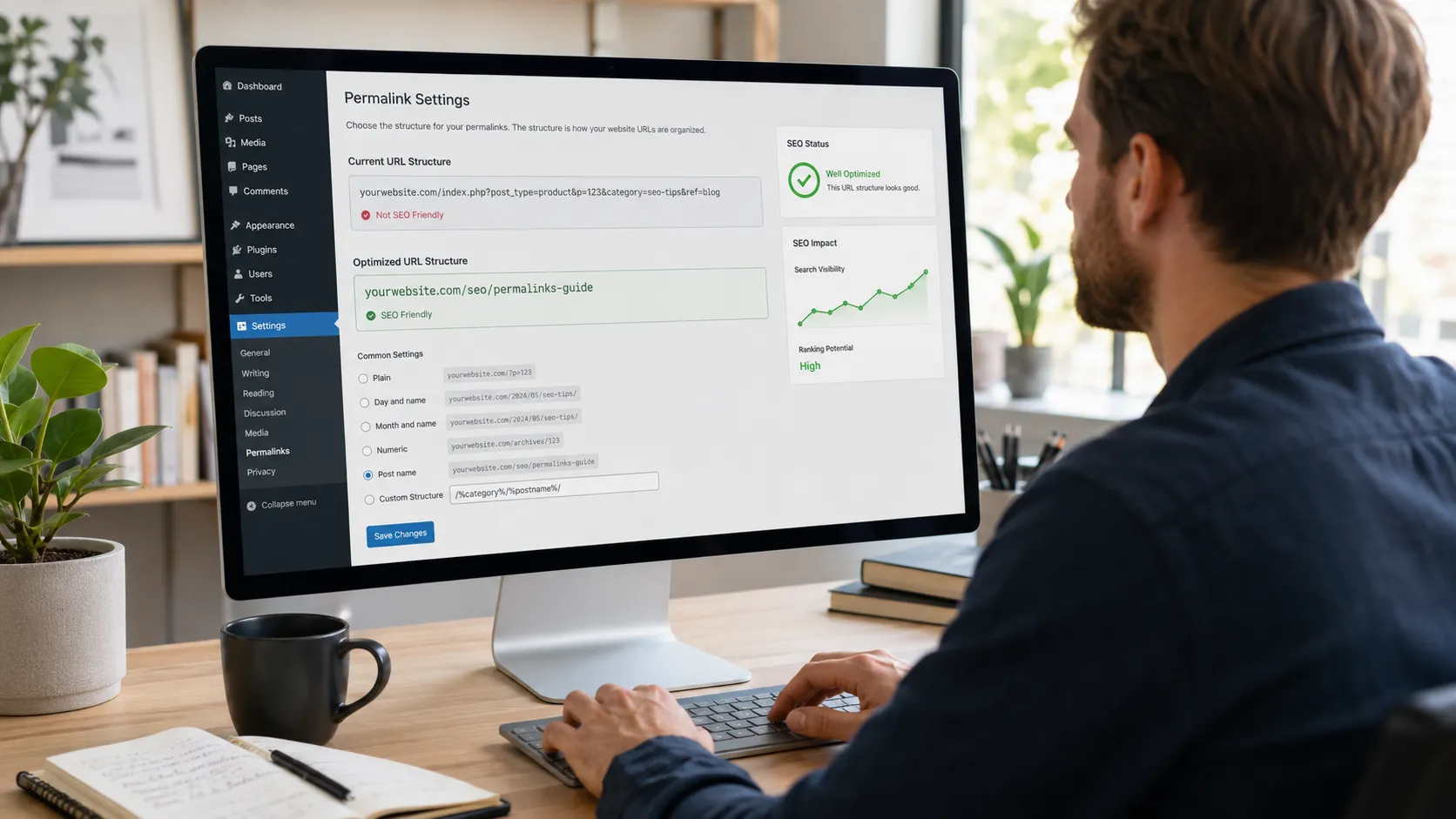

AI search optimization means structuring your website so tools like ChatGPT, Gemini, Perplexity, and Google AI Overviews can read your pages, pull clear answers from them, and name your business in their responses. For a small business site, the work comes down to three jobs: Content has to answer real customer questions in plain language, pages have to stay open and readable for AI crawlers, and brand details have to match everywhere they appear online.
The traffic these tools send is smaller than classic Google traffic, and it converts far better. Microsoft Clarity research found that visitors arriving from AI tools convert up to three times better than traditional organic search visitors. Someone who lands on your site after an AI recommendation already knows what you do, so the conversation starts halfway to a sale.
Key Takeaways
- AI systems read pages in chunks and cite passages, not whole pages, so every section needs to stand on its own.
- GEO builds on traditional SEO instead of replacing it. Sites with weak search foundations rarely earn AI citations.
- SEO stays the base layer in 2026, with AEO and GEO stacked on top for answer boxes and AI mentions.
- A complete website AI optimization covers content structure, schema markup, crawler access, entity clarity, and measurement.
- Clear, specific, well-sourced pages can beat big-brand pages in AI answers, which gives small businesses a real opening.
What Does a Website AI Optimization Include?
A website AI optimization covers mainly six areas of work: content restructuring, schema markup, crawler access, brand consistency, question coverage, and measurement. They turn your site into one that AI systems can read, verify, and quote.
For a local company, location signals run through all six. AI tools answer “near me” style prompts with businesses whose town, service area, and contact details are stated without ambiguity—the same signals a dedicated Fair Lawn local SEO page is built to send. A vague “we serve the tri-state area” line gives them nothing concrete to repeat.
Here is what each area involves:
- Content restructuring. Rewriting key pages so each section opens with a direct answer, headings describe their content, and paragraphs hold one point each.
- Schema markup. Adding Organization, LocalBusiness, Service, and FAQ structured data so machines can confirm who you are and what you offer.
- Crawler access. Reviewing robots.txt and firewall settings so AI crawlers like GPTBot, PerplexityBot, and Google-Extended can reach your pages.
- Entity and brand consistency. Matching your name, address, phone number, and service descriptions across your site, Google Business Profile, and directories.
- Question coverage. Building FAQ blocks and topic pages around the real questions customers type into AI tools.
- Measurement. Tracking AI referral traffic and testing which prompts mention your business.
5 Actionable Steps Small Businesses Can Take to Boost Visibility
These five steps cover the highest-impact work a business owner can handle in-house.
1. Answer One Question Per Section
Pick your five most-visited pages and give every section a heading phrased the way a customer would ask it. Then open each section with a direct two-sentence answer. That structure mirrors how AI systems chunk content, so it lifts your citation odds right away.
2. Add Schema Markup to Key Pages
Structured data tells machines exactly what your business is. Add LocalBusiness schema to your homepage, Service schema to service pages, and FAQ schema to question blocks. Free WordPress plugins handle the markup with no code required.
3. Open the Door for AI Crawlers
Check your robots.txt file and firewall rules for blocks on GPTBot, PerplexityBot, ClaudeBot, and Google-Extended. Some security plugins block these bots by default, which removes your site from AI answers entirely.
4. Keep Business Details Identical Everywhere
Your name, address, phone number, and service list should match word-for-word across your website, Google Business Profile, and directory listings. Mismatched details read as uncertainty, and AI systems skip uncertain sources.
5. Test the Prompts Your Customers Use
Once a month, ask ChatGPT, Gemini, and Perplexity the questions your customers would ask, such as which local web designer comes recommended. Note which businesses get named and which pages get cited. The gaps you find become next month’s content plan.
How Do AI Systems Read and Extract Your Content?
An AI tool does not read your page from top to bottom the way a person does. It splits the page into chunks at natural break points—mostly headings, paragraph breaks, and list items—then scores each chunk against the question at hand. The chunk that answers most cleanly gets lifted into the response, and its page earns the citation.
That mechanic changes what a good page looks like. A long article with vague headings and rambling paragraphs produces chunks that mean nothing out of context. A tightly structured page with descriptive headings and one clear point per paragraph produces chunks that stand alone. Standalone chunks are what AI systems quote.
Each engine applies the mechanic with its own personality. Perplexity retrieves in real time and cites many sources per answer, rewarding fresh, well-structured pages. ChatGPT leans toward consensus references and community discussion. The shared thread is extraction. If a system cannot lift a clean passage from your page, your page does not appear.
The traits below keep showing up in the passages these systems choose to quote:
- The answer appears in the first two sentences of the section, not the last.
- The passage makes sense with zero surrounding context.
- Claims carry specifics, such as numbers, dates, names, and named sources.
- The text lives in plain HTML rather than in images, PDFs, and script-rendered widgets.
Text locked inside an infographic is invisible to the retrieval layer, so a pricing comparison saved as a screenshot will never be quoted.
How Does GEO Differ From Traditional SEO?
Generative Engine Optimization, GEO for short, is the practice of earning citations inside AI-generated answers. Traditional SEO earns rankings on a results page. The two share most of their foundations, and they reward different behavior at the margins.
Traditional SEO asks a page to win a position. GEO asks a passage to win a quotation. That single difference reshapes how you write. Exact keyword placement matters less, since AI retrieval matches on meaning instead of phrases. Clarity, sourcing, and self-contained sections matter far more, since those are the traits extraction systems select for.
| Factor | Traditional SEO | GEO |
|---|---|---|
| Unit of competition | The page | The passage |
| Goal | Rank in a list of links | Get quoted in an answer |
| Matching method | Keywords and links | Meaning and entities |
| Winning trait | Authority and relevance | Clarity and verifiability |
| Success metric | Positions and clicks | Citations and mentions |
Neither discipline works alone. AI systems lean on classic search indexes to build their candidate pools, so a site lacking a solid SEO service program struggles to enter the pool at all. Bill Gates put it plainly back in 1996 with the line “Content is king,” and AI search has made that claim more literal than ever. The engines now quote content word-for-word.
SEO vs AEO vs GEO and Which One Matters Most in 2026
Three acronyms now compete for a small business owner’s attention, each targeting a different surface. SEO wins positions in classic ranked results. AEO, short for Answer Engine Optimization, wins featured snippets, PAA question boxes on Google, and voice assistant replies. GEO wins citations inside generative answers from ChatGPT, Gemini, and Perplexity.
| SEO | AEO | GEO | |
|---|---|---|---|
| Target surface | Ranked search results | Snippets, PAA, voice | AI-generated answers |
| Content style | In-depth pages | Short direct answers | Sourced, quotable passages |
| Typical query | Keyword phrases | Direct questions | Conversational prompts |
| Payoff | Clicks and traffic | Instant visibility | Recommendations and trust |
So which one deserves your budget in 2026? SEO still does the heavy lifting, and it is not the whole job. Treat the three as a stack. SEO gets your pages indexed and trusted, AEO shapes them into direct answers, and GEO makes those answers quotable by AI systems. Picking one and ignoring the rest leaves visibility on the table at some stage of the customer journey.
The overlap is the good news for a small budget. Work done for one layer feeds the other two. A service page with a question-based heading, a direct two-sentence answer, and a named source performs on all three aspects at once.
Get Your Website Ready for AI Search
H Grant Designs helps Bergen County and New Jersey small businesses show up in AI answers, not just ranked results. We handle the full scope above, from content restructuring and schema markup to crawler access and local signal cleanup. Reach out through our contact page for a plain-English review of where your site stands today.
Frequently Asked Questions
What is AI search optimization?
It is the process of structuring your website so AI tools like ChatGPT, Gemini, and Google AI Overviews can understand your business, extract answers from your pages, and recommend you in their responses.
Is SEO still relevant now that people search with AI?
Yes. AI systems build their answers from sources surfaced by classic search indexes, so a site with weak SEO rarely enters the candidate pool at all. SEO remains the foundation that AEO and GEO build on.
What is the difference between AEO and GEO?
AEO targets direct-answer features inside traditional search, such as featured snippets and PAA question dropdowns on Google results. GEO targets citations inside AI-generated responses from tools like ChatGPT and Perplexity. AEO wins a box on a results page, and GEO wins a mention inside a written answer.
How do I optimize my small business website for AI search?
Start with structure. Give every key page descriptive headings. Open each section with a direct answer. Add FAQ and LocalBusiness schema. Confirm AI crawlers are not blocked in robots.txt, and keep your business details identical everywhere.
How long does AI search optimization take to show results?
Most small businesses see early movement within twelve to fifteen weeks. AI systems refresh their retrieval sources on different schedules, so citations build gradually rather than appearing overnight.