
Most business websites don’t fail because of a lack of traffic; they fail because they don’t convert visitors into leads.
According to HubSpot, 61% of marketers say generating traffic and leads is their biggest challenge. For NJ businesses competing in local markets, this makes your website one of the most important tools for growth.
A WordPress website generates leads when it combines SEO to attract the right visitors, structured pages to guide them, and conversion-focused design to capture their information.
In practice, this means businesses rank for relevant searches, bring users to well-organized service pages, guide them with clear calls-to-action, and convert them through forms, landing pages, or consultations.
When these elements work together, the website stops being just an online presence and becomes a consistent lead generation system. Generating leads starts with the right structure, so you want a site structured to convert visitors into enquiries.
The Lead Generation System
Lead generation is not random. It follows a clear process where each step supports the next.
| Stage | What Happens | Outcome |
|---|---|---|
| SEO | Visitors arrive | Traffic |
| Structure | Users navigate | Engagement |
| Design | Trust builds | Interest |
| CTAs | Action taken | Leads |
| Follow-up | Leads nurtured | Customers |
Most websites fail because they focus only on one part of this system—usually traffic. However, traffic alone does not produce results. If users are not guided properly or do not see a reason to take action, they leave without becoming leads.
The businesses that consistently generate leads are the ones that build their websites around this full system, not just one component.
1- SEO
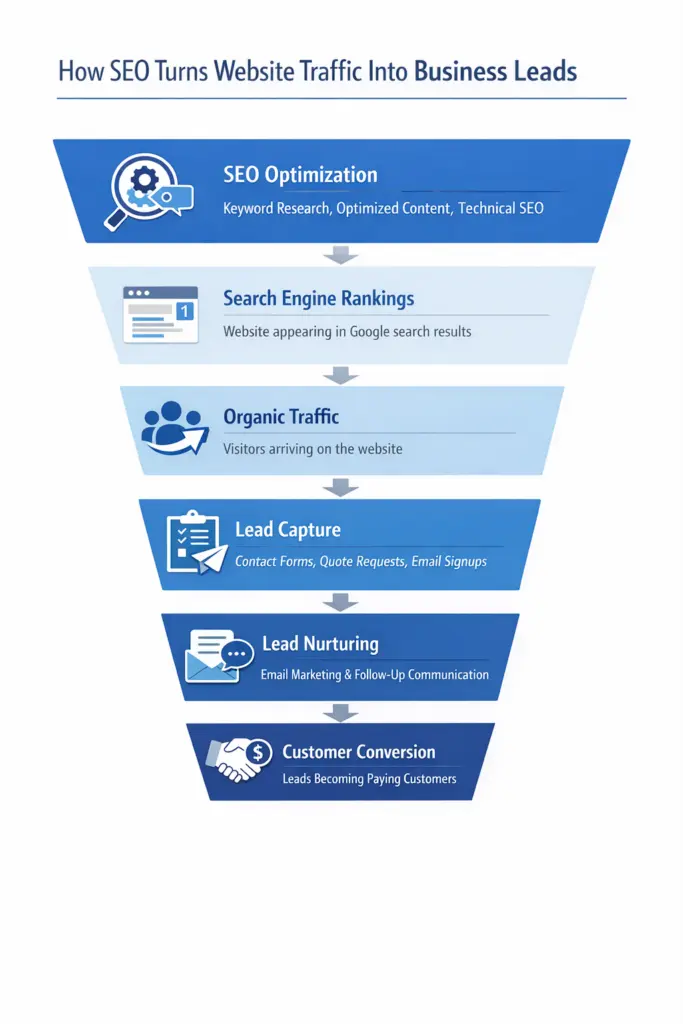
Search engine optimization is the starting point of this process. It brings users who are already searching for services, which makes them far more likely to convert.
According to BrightEdge, 68% of online experiences begin with a search engine. This means most potential customers are actively looking for solutions online before making a decision.
For example, a user searching for “WordPress web design NJ” or “website services near me” is not browsing casually; they already have a problem they want solved. If your website appears in these results, you are meeting them at the right moment.
For NJ businesses, local SEO is especially important. Targeting location-based keywords such as city names, service areas, or “near me” searches helps attract nearby customers who are ready to take action.
SEO-driven traffic is valuable because it is intent-based. These visitors are not random—they are actively looking for services, which increases the chances of generating leads.
2- Website Structure
Once visitors land on your website, the next step is keeping them engaged. This is where website structure becomes critical.
If users cannot quickly understand what your business offers or where to go next, they leave. A clear structure helps guide visitors through your website and keeps them engaged long enough to take action.
Effective websites are organized into logical sections such as service pages, about pages, and contact pages. Each page serves a specific purpose and is connected through internal links, allowing users to move through the site naturally.
For example, instead of placing all services on one page, businesses that create dedicated service pages for each offering can target specific keywords and improve both SEO and user experience.
Businesses that invest in structured website design often see improvements in both usability and visibility.
A well-structured website reduces confusion, increases engagement, and helps visitors move closer to becoming leads.
3- Conversion-Focused Design
Traffic and engagement are important, but leads are generated at the conversion stage. This is where most websites fail.
A conversion-focused website is designed with one goal in mind: guiding visitors toward taking action. Without this structure, even high traffic levels will not produce meaningful results.
4- Strategic Call-to-Actions
Visitors need clear direction. If they do not know what to do next, they will leave without interacting with your business.
Call-to-actions (CTAs) provide that direction. These are the buttons or prompts that encourage users to take the next step, such as contacting the business or requesting a quote.
Effective CTAs are placed strategically across the website, including at the top of the page, within service sections, and at the end of key content.
Clear and direct messaging such as “Get a Quote” or “Book a Consultation” removes uncertainty and makes it easier for visitors to take action.
5- Landing Pages Drive Higher Conversions
Landing pages are one of the most effective tools for generating leads because they focus on a single objective.
According to WordStream, landing pages convert at an average rate of 9.7%, which is significantly higher than most standard website pages.
Unlike general pages, landing pages are designed to remove distractions and guide users toward one specific action. This focused approach increases the likelihood that visitors will convert into leads.
For example, a landing page offering a free consultation or service estimate can capture significantly more leads than a general service page.
6- Lead Capture Systems Turn Visitors Into Contacts
To generate leads, a website must capture visitor information. Without this step, even interested users leave without any way for the business to follow up.
Lead capture systems include tools such as contact forms, email signup forms, and live chat features. These allow businesses to collect information from visitors and begin the conversion process.
This is the point where a visitor becomes a lead. Without proper lead capture systems in place, traffic and engagement do not translate into real business opportunities. Lead generation works best alongside local best practices for NJ sites.
7- Trust and Credibility
Even with strong SEO and structure, visitors will not take action unless they trust your business.
According to the Stanford Web Credibility Project, 75% of users judge a company’s credibility based on its website design. This means design is not just about appearance—it directly influences whether a visitor becomes a lead.
Trust is built through a combination of visual presentation and proof. A clean, professional layout signals reliability, while elements such as testimonials, reviews, and certifications reinforce that trust.
For example, when a visitor sees real client feedback or case studies, it reduces uncertainty and increases confidence in your services. This makes them more likely to contact you.
8- Website Speed and Performance
Website performance plays a major role in both user experience and lead generation.
Google reports that 53% of users leave a website if it takes longer than 3 seconds to load. This means that even if your website attracts traffic, slow loading speeds can cause you to lose potential leads before they even see your content.
Speed affects multiple areas:
- user engagement
- bounce rate
- search rankings
A slow website creates frustration, while a fast website keeps users engaged and encourages them to explore further.
Improving performance involves optimizing images, using reliable hosting, and reducing unnecessary scripts or plugins. These improvements may seem technical, but they directly impact how many visitors stay on your website long enough to convert.
Why WordPress Is Ideal for Lead Generation
WordPress is widely used for business websites because of its flexibility and scalability. Unlike rigid website builders, it allows businesses to build and improve their websites over time.
One of the main advantages of WordPress is its ecosystem of plugins and integrations. Businesses can easily add tools for SEO, lead capture, analytics, and performance optimization.
This flexibility allows companies to continuously improve their websites based on performance data. For example, businesses can test different layouts, improve page speed, or add new landing pages as their marketing strategy evolves.
Optimizing functionality is a key part of improving website performance and lead generation.
Because WordPress supports both SEO and conversion-focused design, it becomes a strong foundation for building a lead generation system. Pair your site with our search engine optimization help to bring in steady traffic.
Common Lead Generation Mistakes Businesses Make
Many businesses invest in websites but fail to generate leads because of avoidable mistakes.
| Mistake | Problem | Impact |
|---|---|---|
| No clear CTAs | Users don’t know what to do | Lost leads |
| Poor user experience | Confusing layout | High bounce rate |
| Weak SEO | Low visibility | Limited traffic |
| Slow website | Performance issues | Lost conversions |
These issues prevent websites from functioning as effective marketing tools. Fixing them often leads to immediate improvements in both engagement and lead generation.
Why This Matters for NJ Businesses
Local competition makes website performance even more important. In NJ, customers often compare multiple businesses before making a decision.
When users search for WordPress web design services, they typically visit several websites before choosing one. A website that is faster, clearer, and easier to navigate has a significant advantage.
For example, two businesses may offer similar services, but the one with a better website experience is more likely to generate the lead.
This is why NJ companies that invest in structured, conversion-focused websites often outperform competitors who rely on basic or outdated designs.
Signs Your Website Is Not Generating Leads
Websites often show clear signs when they are not performing effectively. Recognizing these signs early can help businesses make necessary improvements.
| Sign | Meaning | Impact |
|---|---|---|
| Low traffic | Weak SEO strategy | Missed opportunities |
| Few inquiries | Poor conversion design | Lost revenue |
| High bounce rate | Poor user experience | Low engagement |
| Outdated design | Lack of updates | Reduced trust |
If these issues are present, it usually indicates that the website is not properly optimized for lead generation.
Frequently Asked Questions
How do WordPress websites generate leads?
They generate leads by attracting traffic through SEO and converting visitors through structured design, CTAs, and lead capture systems.
Is WordPress good for local businesses?
Yes. WordPress provides flexibility, SEO capabilities, and tools that help businesses attract and convert local customers.
What improves website conversion rates?
Clear calls-to-action, fast loading speed, strong design, and trust signals all contribute to higher conversion rates.
Do small businesses need landing pages?
Yes. Landing pages are highly effective for capturing leads because they focus on a single goal.
How long does it take to generate leads from SEO?
SEO typically takes several months to show results, but it provides long-term, consistent traffic once established.
Conclusion
A WordPress website can be one of the most effective tools for generating leads when it is built correctly. It is not just about attracting visitors, guiding them, building trust, and converting them into customers is the real deal.
When SEO, website structure, and conversion-focused design work together, businesses can create a system that consistently generates leads.
For NJ companies, where local competition is strong, having a well-optimized website is not optional. It is a key factor in attracting customers, staying competitive, and driving long-term growth.